
NGC 2024 and Barnard 33
Flame and Horsehead Nebula
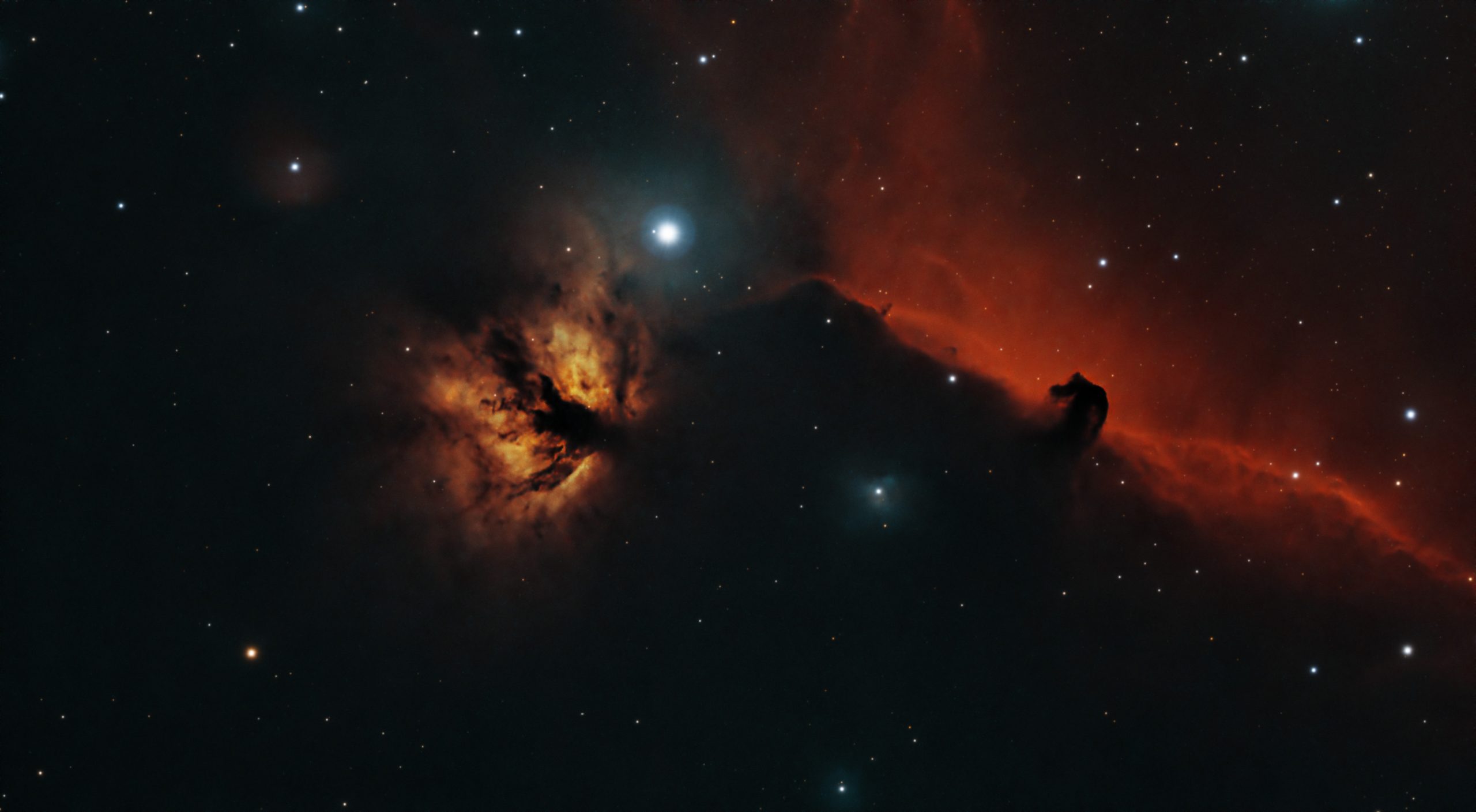
The Flame and Horsehead nebulae stand out as two of the most iconic and visually striking deep-sky objects, both situated within the well-known constellation of Orion. These nebulae are integral components of the vast and complex Orion Molecular Cloud Complex, an extensive region of space located approximately between 1,300 and 1,500 light-years away from Earth. This incredible celestial area is a bustling stellar nursery, where new stars are continuously and actively forming, contributing to the ongoing evolution of our galaxy.
Key Characteristics
The Horsehead Nebula (Barnard 33)
NGC 2024 and Barnard 33 – Flame and Horsehead
A dark nebula, which is a cold, dense cloud of gas and dust.
Appearance:
It is famous for its silhouette that resembles a horse’s head, created as it blocks light from the bright red emission nebula (IC 434) behind it.
Discovery:
It was first recorded in 1888 by Scottish astronomer Williamina Fleming.
The Flame Nebula (NGC 2024)
Type:
An emission nebula.
Appearance:
It has a fiery, orange glow with dark dust filaments that look like smoke.
Mechanism:
Its glow is powered by the intense ultraviolet light from the nearby star Alnitak, which ionises the surrounding hydrogen gas.