
Barnard 150
Seahorse Nebula
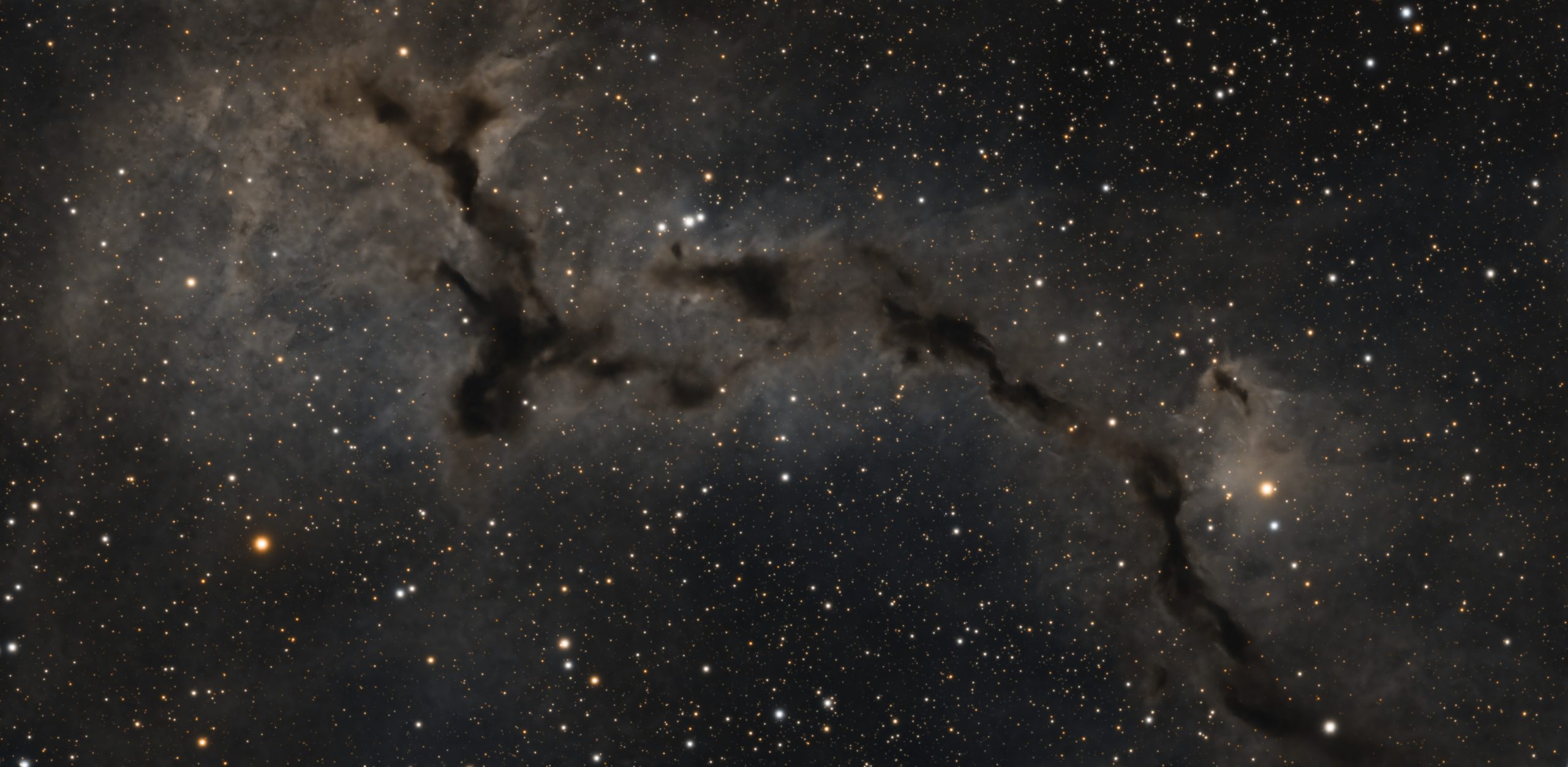
Barnard 150, widely recognized and popularly referred to as the Seahorse Nebula due to its distinctive shape, is a prominent dark molecular cloud situated within the boundaries of the constellation Cepheus. This intriguing nebula forms a part of our own Milky Way galaxy and is positioned at an estimated distance of about 1,200 light-years from Earth, making it relatively close in astronomical terms.
Key Characteristics
Discovery:
It was cataloged in the early 20th century by American astronomer Edward Emerson Barnard, who identified 182 such “dark markings” in the sky.
Classification:
It is a dark nebula, a dense region of interstellar dust and gas that does not emit its own visible light. Instead, it appears as a dark silhouette by blocking the light from stars behind it.
Structure:
The nebula spans about 1 degree in the sky, which is roughly twice the width of a full moon. Its physical size is estimated at 5–6 light-years across.
Star formation:
It contains three highly dense dust cores (cataloged as LDN 1082 A, B, and C) that serve as active regions for star formation.
Distance:
It is approximately 1,200 light-years away from Earth.