
NGC 4631 & 4656
Whale And The Hockey Stick Galaxy
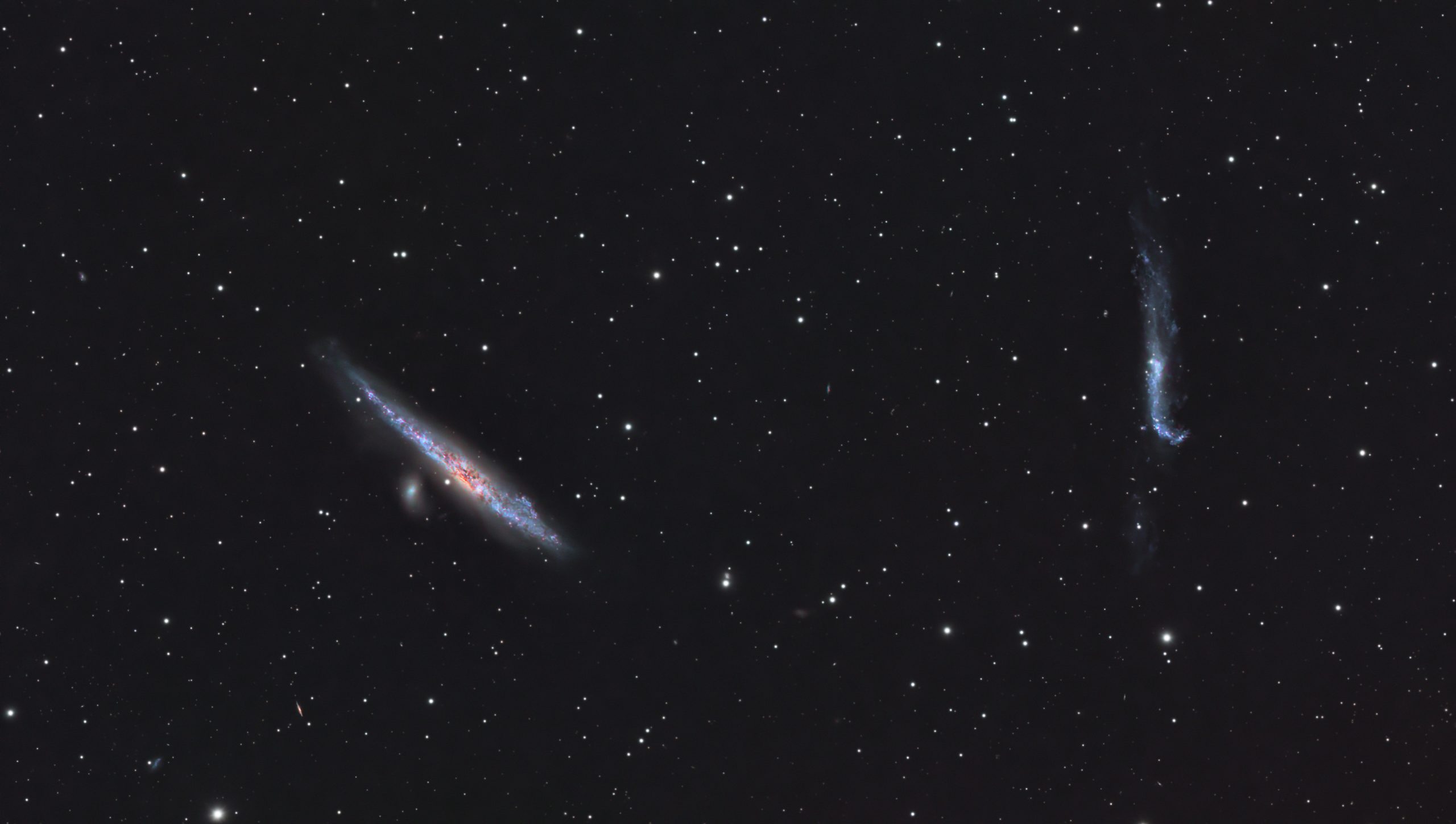
The “Whale” (NGC 4631) and “Hockey Stick” (NGC 4656/4657) galaxies are a famous interacting pair of edge-on spiral galaxies in the constellation Canes Venatici, about 30 million light-years away, named for their distinct shapes caused by gravitational interactions, with the Whale’s warped disk and the Hockey Stick’s kink resulting from a recent close encounter and potential merger. These galaxies offer astronomers a chance to see galactic structures from the side, revealing dust lanes, star formation, and tidal distortions.
Key Characteristics
The Galaxies:
Whale Galaxy (NGC 4631): A larger, wedge-shaped barred spiral galaxy seen from the side, showing dark dust lanes and star-forming regions.
Hockey Stick Galaxy (NGC 4656/4657): A smaller, highly warped barred spiral with a distinctive kink or hook, caused by gravitational forces. NGC 4657 is the “hook” part.
Companion (NGC 4627): A dwarf elliptical galaxy near the Whale, also involved in the gravitational disturbance.
Their Relationship:
Gravitational Dance: The galaxies are locked in a gravitational interaction, causing NGC 4631’s warped disk and NGC 4656’s unusual shape.
Future Merger: They are expected to eventually merge into a single, larger galaxy.
What makes them Special
Edge-On View: Seeing them from the side allows us to view galactic structures like dust and gas in profile.
Star Formation: The violent gravitational interactions trigger bursts of star formation, creating bright, young blue stars, especially visible in the Hockey Stick.
Peculiar Galaxies: They are listed in the Atlas of Peculiar Galaxies due to their distorted shapes, showing ongoing galactic evolution.
Distance:
Approximately 25-30 million light-years from Earth.