
M51
Whirlpool Galaxy
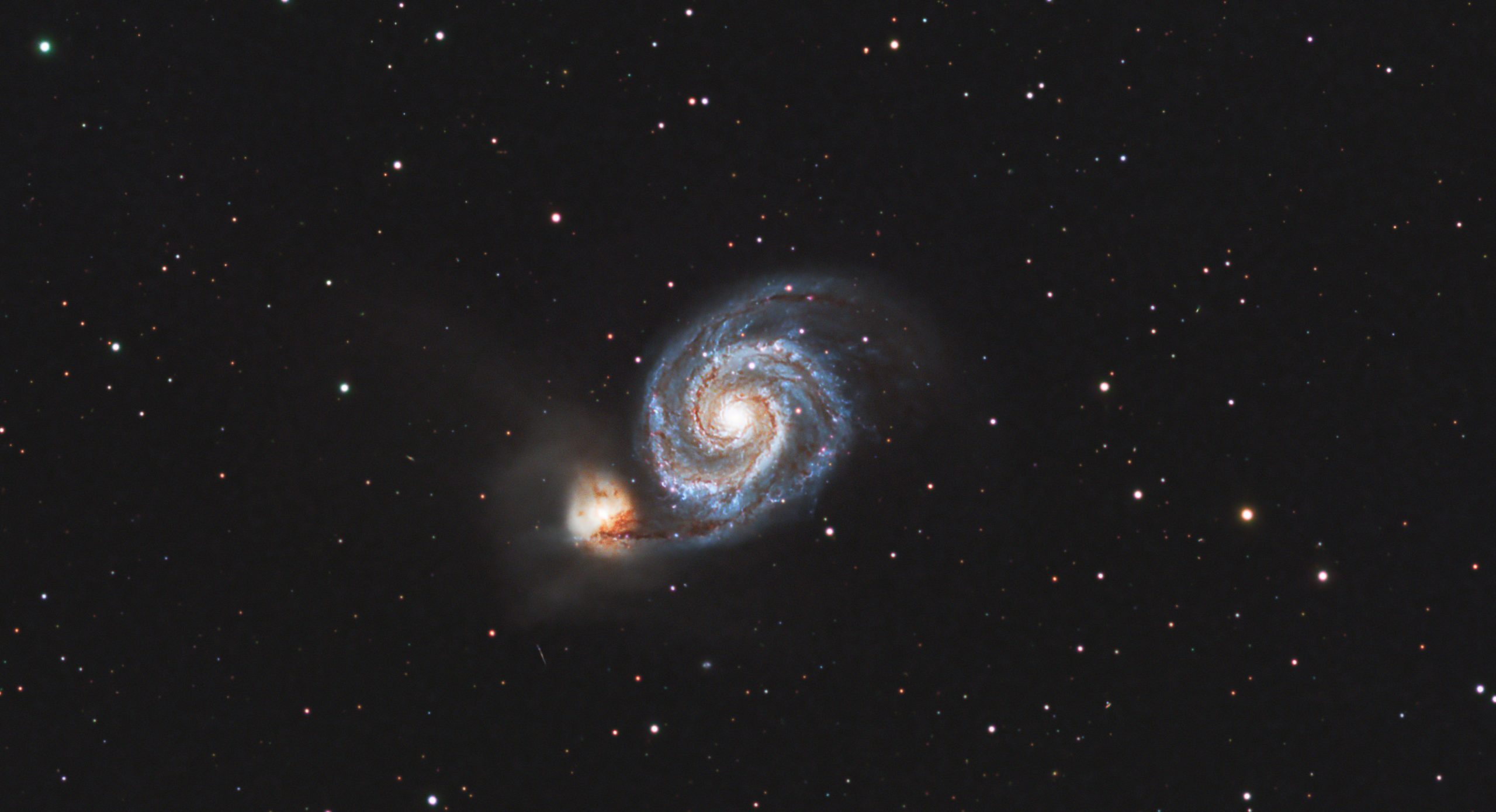
The Whirlpool Galaxy (M51) is a well-known and striking example of a “grand-design” spiral galaxy, situated at an estimated distance of about 23 to 31 million light-years from Earth within the constellation Canes Venatici. This galaxy holds a special place in astronomical history as it was the very first galaxy to be identified and classified as possessing a distinct spiral structure, a groundbreaking discovery made by the astronomer Lord Rosse back in 1845.
Key Characteristics
Structure:
It is a classic face-on spiral galaxy, meaning we see its full disk and prominent arms clearly from Earth.
Interacting Pair:
M51 is actually a pair of interacting galaxies; the larger spiral is designated NGC 5194 (or M51a), and its smaller, yellow dwarf companion is NGC 5195 (or M51b).
star formation:
The gravitational interaction between the two galaxies triggers intense star formation, visible as bright blue star clusters and pinkish-red hydrogen emission regions in the spiral arms.
Galactic Core:
M51 has a Seyfert 2 active galactic nucleus, which astronomers believe houses a supermassive black hole.
Size and mass:
It spans approximately 60,000 to 77,000 light-years in diameter—roughly 75-88% the size of the Milky Way—and contains an estimated 100 billion stars.